
Sitting on the terrace one day, I noticed an open window’s glass reflecting the blue sky, a tree, some buildings and the green shade above our terrace. Alas! It wasn’t a perfect reflection, for the window bore some white paint droplets, which had probably trickled down from its edges back when the window was originally painted. Whatever angle I would set the window to, every scene it reflected bore the presence of the trickled white paint.
It gave rise to an interesting thought, a possible analogy of how we reflect upon various matters. Imagine as we entered this world we carried a reflector, with a surface as clear and innocent and impressionable as our mind. And so as we grow older, a variety of experiences adorn the surface: portions painted in various hues (the possible origin of “rose tinted glasses”?); portions marred by the cruelty of this world; and portions polished to maintain clarity of thought. It very easily explains why people have different takes on the same subject when asked for an opinion!
Some thoughts do to the mind what cold weather does to your car’s window, temporarily hindering visibility.
Sometimes a single emotion can cover the entire surface so that every experience is drenched in its color (happiness “lighting” up the world, or sadness “creeping” in every thought). Sometimes the surface changes color like a chameleon or becomes an artist’s color palette.
But like a tea stain takes more effort to remove than a speck of dust on a surface, some experiences have such an impact that they can last a lifetime.
Amongst all this, is an obvious observation: this reflector is quite special, for it has the ability to be restored to its pristine form.
But do we want it to remain pristine?
A pristine reflector might be equivalent to an objective perception of matters, which surely save us the trouble our overthinking tendencies create in everyday life.
However, as Feynman once described how a flower’s beauty is not limited to the dimension in which we see it1, similarly this reflector’s aim isn’t to always present a matter simply “as it is”.
Maria Popova explains in one of her beautiful articles how information forms the base of the ladder of understanding2, and as one climbs up that ladder, one acquires knowledge, and eventually, wisdom. While knowledge helps us understand how the world works, it is wisdom which equips this understanding with a moral compass of how the world should ideally work. So Lady Wisdom steers the reflector to the right direction, and provides a deeper insight of a subject.
Imagine if Snow White’s stepmother had bothered to have an enlightened mirror instead, which could, through its wisdom, have guided her that external beauty isn’t everything!
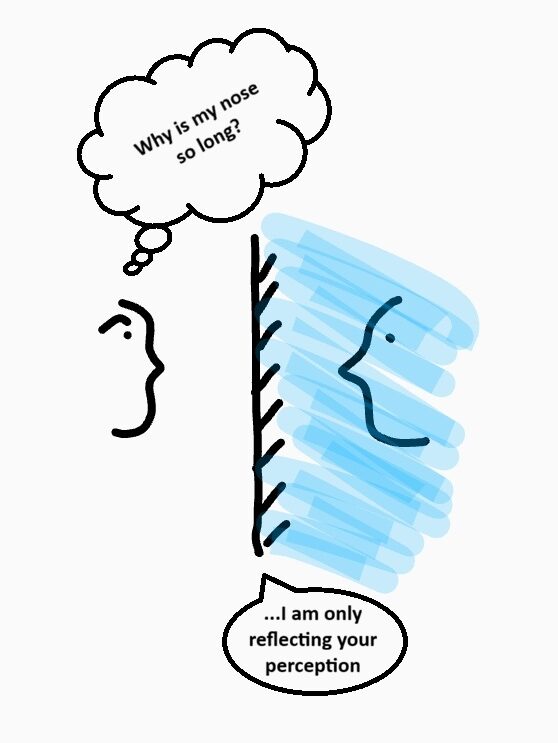
As we all have the capacity to learn and grow at any stage in life, I hope that we all explore the world with open eyes and an open mind and try to attain wisdom, and make a better difference to this world. So that the minds that come to this world after us don’t have to add unrealistic optimism filters on their reflectors, but rather be residents of an optimistic, nurturing world!
P.S. If you wish to reflect on reflecting, I suggest this beautiful disney song in the backdrop ;)) : http://open.spotify.com/track/4ASPjY65S7crmZBHML0L8d
- https://www.youtube.com/watch?v=ZbFM3rn4ldo ↩︎
- https://www.themarginalian.org/2014/09/09/wisdom-in-the-age-of-information/ ↩︎
Originally written on 4th May 2020, edited and posted on 7th April 2026.